


Review Content Faster for AI
We help you detect AI text and manage content quality at scale.
What Is an AI Checker?
An AI checker is a detection tool designed to analyze written content and assess the likelihood that it was produced by artificial intelligence. It works by examining writing patterns, sentence structure, word predictability, and stylistic consistency commonly found in AI generated text. Using an AI detection model, the tool provides a probability score that helps users identify AI generated text and distinguish it from human written content. Artificial Intelligence checkers are commonly used in academic settings, publishing, and professional writing workflows to support academic integrity, content quality, and responsible use of AI tools.
Who Uses AI Checkers?
AI checkers are being adopted by students, authors, bloggers, researchers, publishers, and digital marketing professionals because the volume of content has made manual checking harder to scale.
Content quality drifts when drafts move too fast, and originality becomes harder to verify when AI generated writing blends smoothly with human written text. A careful human editor can catch some issues, but scale changes the rules. Reading everything line by line stops being realistic once output increases.
AI checkers step in as support tools, not replacements. They help analyze writing patterns, flag sections that may read as AI generated, and give teams a clearer signal before content is published. Used responsibly, they strengthen review workflows, protect academic integrity, and let humans focus on judgment rather than guesswork.
How an AI Checker Shapes Smarter Content Creation
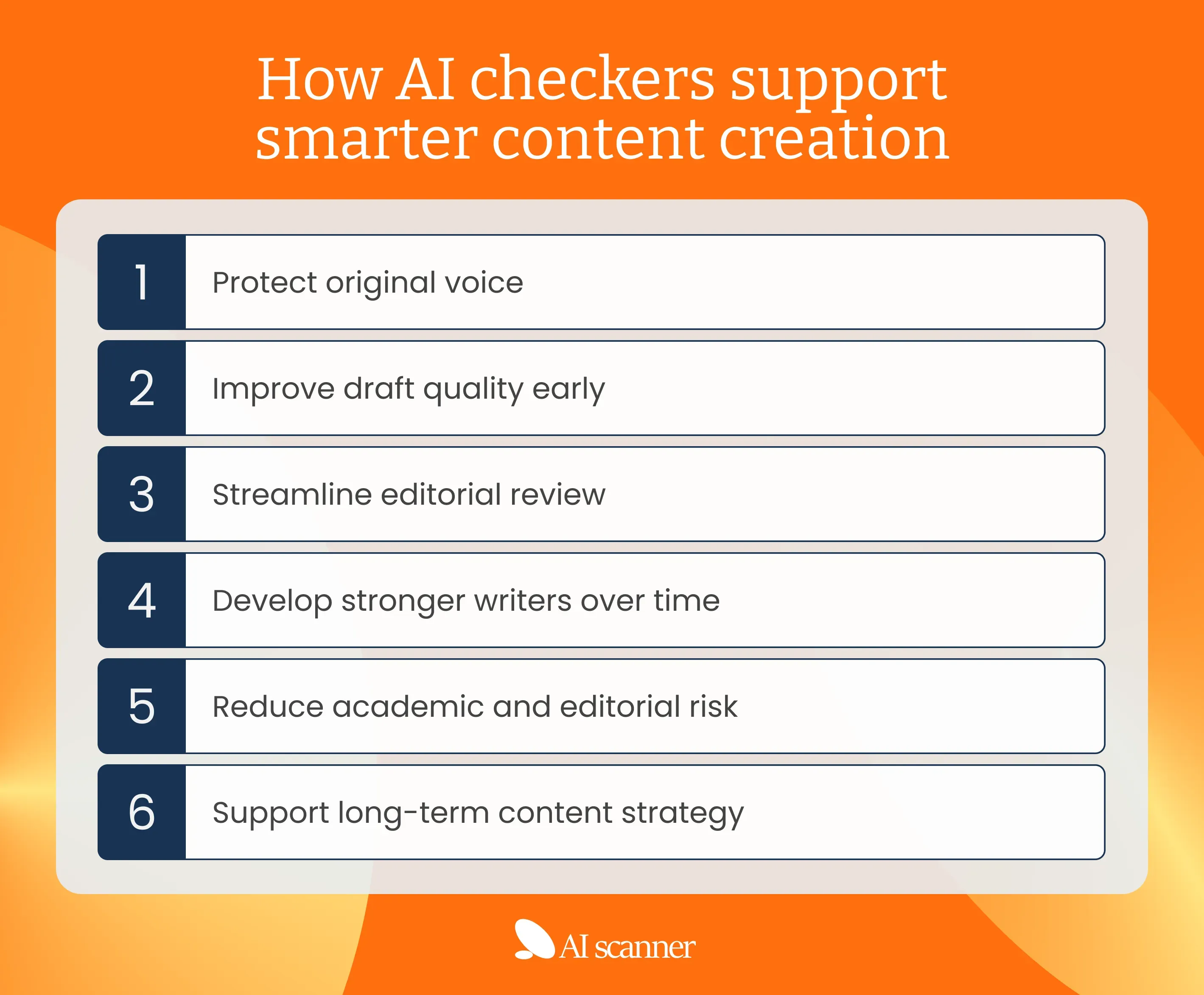
An AI detection strengthens content creation strategies by adding structure where intuition alone no longer scales. Each section below looks at a different way AI checkers support content creation, from shaping originality to strengthening long-term strategy.
Strengthens Originality and Authorial Voice
AI checkers help creators recognize wording that feels generic, formulaic, or overly polished. These signals often point to AI generated phrasing that blends in quietly. By identifying those sections, students, bloggers, and authors can reshape ideas in their own voice. Over time, writers become more aware of how their natural style differs from AI patterns, which leads to stronger, more confident human written content.
Improves Content Quality Before Publication
An AI checker surfaces stylistic friction points early, highlighting predictable phrasing, tonal drift, or overly uniform sentence patterns before readers encounter them. Writers respond while the text is still malleable, reshaping flow, reinforcing logic, and smoothing transitions without tearing the draft apart. This early feedback signal is critical for assignments, long-form articles, and research writing, where small inconsistencies quietly erode trust. With a structured pre-publish review, revisions shrink, and the final piece reads as intentional, composed, and confidently finished rather than patched together at the end.
Makes Editorial and Review Workflows More Efficient
Editors, publishers, and content managers rely on AI checkers to manage volume without losing oversight. Instead of manually reviewing every draft in depth, teams use detection signals to prioritize attention. This approach saves time when reviewing large batches of content, guest submissions, or marketing assets. Detection tools handle early pattern analysis, allowing editors to focus on meaning, accuracy, and editorial judgment.
Turns Feedback Into Writer Development
AI checkers do more than flag issues once. Repeated feedback helps writers notice recurring habits in AI assisted drafts, such as predictable phrasing, compressed arguments, or a flattened tone that lacks emphasis. Students begin to understand where AI influence shows up in their writing and how to push past it. Teams can track patterns across multiple drafts, using real data to refine style guides and expectations. Over time, writers stop reacting to corrections and start writing with intention built in. Drafts move faster, revisions shrink, and stylistic choices become more deliberate rather than accidental. As awareness grows, writers recognize patterns before they appear on the page. In this role, AI checkers function as ongoing learning tools, shaping long-term skill development instead of serving as one-off detectors.
Lowers Risk in Academic and Professional Work
In academic and professional contexts, content carries real consequences. AI checkers help surface material that could raise questions around academic integrity or editorial standards before submission. Early signals reduce disputes, rewrites, and credibility risks. Used responsibly, the tool supports compliance, transparency, and trust in environments where authorship and originality matter.
Using AI Checkers as Part of a Content Creation Strategy
Strong content strategies depend on originality, clarity, and natural language consistency over time. An AI checker supports these goals by keeping quality signals consistent as output grows. Marketers and publishers use it to maintain standards across platforms, contributors, and formats. The result is content creation that scales without drifting, staying readable, credible, and recognizably human.
Strategic Use of AI Checkers in the Content Creation Workflow
Using AI checkers strategically comes down to timing and intent. In content workflows, the tool works best when it supports decision-making rather than interrupts creativity. Applied at the right moments, AI checkers add clarity, reduce uncertainty, and help teams keep quality consistent as output grows. The goal is not constant monitoring, but targeted use where feedback actually improves the draft.
That value becomes most obvious at a few specific points in the content creation process:
- Early drafting stages, when large AI patterns can be identified before they shape the structure
- Midway editing, where tone drift, repetition, or over-polished sections tend to appear
- Pre-publish review, when small refinements improve clarity and originality without major rewrites
- High-volume content production, where manual review alone no longer scales
Know How Your Content Reads
AI Scanner gives clear signals before you publish or submit.
Bringing It All Together
AI checkers have become part of how modern content gets made, reviewed, and trusted. Across roles, the value stays consistent with clearer signals, better decisions, and fewer surprises late in the process.
What AI checkers offer is support, not substitution. They enhance content quality, strengthen confidence before publishing, and help creators stay in control of their work without flattening creativity. AI Scanner fits naturally into this approach, giving teams a reliable way to detect AI generated content and refine content while keeping human intent at the center.
FAQs
Sources
- Texas Tech University Libraries. (2025). Artificial intelligence tools for detection, research and writing. Texas Tech University. https://guides.library.ttu.edu/artificialintelligencetools/detection
- Content Marketing Institute. (2025). AI content detection tools exist – But do you need them (and can you trust them)? Content Marketing Institute. https://contentmarketinginstitute.com/ai-content-creation-tools/ai-content-detection-tools-exist-but-do-you-need-them-and-can-you-trust-them?
- Brandeis University. (n.d.). Limitations of AI detection tools. Brandeis University Artificial Intelligence Steering Council. https://www.brandeis.edu/ai-steering-council/ai-literacy/ai-teaching-learning/detection-tools.html