

What are AI Text Detectors?
AI text detectors are software systems that analyze written content to determine the likelihood that it was produced by artificial intelligence rather than a human writer. They look closely at how the text is written rather than what it says. This includes things like how long the sentences are, how often certain words repeat, how predictable the phrasing is, and how much variation appears across the passage. Using machine learning and natural language processing, the detector compares these patterns with large samples of human written text and AI generated content. Based on that comparison, it estimates whether the writing resembles typical AI outputs or natural human writing.
Unsure If Your Text Looks AI-Written?
AI Scanner analyzes writing patterns, structure, and predictability to show how your content is perceived by detectors.
How Do AI Text Detectors Work?
At a basic level, AI content detectors work by scanning writing for patterns that tend to show up more often in AI output than in human writing. A common question is what do AI text detectors look for. The answer lies in how predictable the language feels, how sentences are structured, and how consistently those patterns repeat across a text.
Machine Learning Models Behind Detection
AI text detectors use machine learning models trained on large sets of human written text and AI generated text. During training, the model learns statistical patterns that appear frequently in AI outputs, such as uniform sentence length or repeated phrasing styles. When new content is analyzed, the model compares it against those learned patterns and estimates how closely the writing resembles known AI behavior.
How Natural Language Processing Analyzes Writing Patterns
AI text detectors use natural language processing to break writing into measurable language features. NLP allows the system to examine sentence structure, word choice, flow, and predictability at a granular level. By analyzing how language unfolds across paragraphs, the detector can spot signals that suggest automated generation rather than organic human writing.
How Classifiers and Embeddings Sort Writing Patterns
AI text detectors also rely on classifiers and embeddings to make sense of writing at scale. Embeddings turn words, sentences, and paragraphs into numerical representations that capture meaning and relationships between terms. Classifiers then use those representations to sort text into probability categories, estimating whether it aligns more closely with human writing or AI-generated output.
How Accurate Are AI Text Detectors in Practice?
AI text detectors can offer helpful signals, but their accuracy is limited. Research shows that many tools struggle to perform consistently across different types of writing. For example, a 2023 evaluation published in SN Computer Science tested 14 widely used AI detection tools and found that none achieved accuracy above 80 percent. Only five detectors exceeded the 70 percent range, and performance dropped further when texts were edited or partially rewritten by humans.
These limits come from the ways AI text detectors work. Most rely on probability models that compare writing patterns against training data rather than confirming authorship. Because polished human writing can resemble AI output, false positives are common, especially in academic or professional texts. False negatives also occur when AI content is revised enough to blur detection signals.
How AI Scanner Works and How Accurate It Is
AI Scanner analyzes writing using the same principles as modern detection systems, while avoiding the common pitfalls that lead to unreliable results. It examines sentence structure, word choice, predictability, and variation across a text, then compares those patterns against large sets of human-written and AI-generated content. Multiple indicators are weighed together to produce a balanced likelihood assessment rather than relying on a single signal.
Accuracy comes from restraint as much as analysis. AI Scanner is built to account for context and pattern balance, which helps reduce false positives in formal or polished human writing. Instead of forcing binary judgments, it provides a clearer view of how strongly a text aligns with known AI writing behavior.
Technically, the system combines linguistic modeling, deep learning, and proprietary AI logic to detect generative content with high precision. It recognizes output from major AI models, including:
- Gemini
- Claude
- DeepSee
- Grok
- Llama
By focusing on writing behavior rather than model-specific traits, AI Scanner delivers more consistent and trustworthy results.
Key Methods AI Text Detectors Use
Here are the core methods AI text detectors use to evaluate writing, explained plainly and without jargon overload:
- Stylometry and vectorization: One of the main methods of AI text detectors involves turning language into numbers. Detectors map word meanings and relationships into vectors, then look for subtle patterns in phrasing, repetition, and n-grams that often appear in AI outputs.
- Metadata and trace signals: Some detectors examine technical traces left during content generation, such as formatting consistency or generation markers, when available. These signals are supportive rather than decisive.
- Repetition and uniformity analysis: Detectors flag writing that shows unusually steady sentence length, repeated phrasing, or overly consistent rhythm, which can signal automated generation.
- Dataset comparison: Text is compared against large collections of known human and AI-written content. The detector checks stylistic similarity and assigns likelihood scores based on those matches.
Perplexity
Perplexity explains how predictable a piece of writing is. The detector checks how likely each word is to appear based on the words around it. AI systems often choose statistically safe, common sequences, which makes their text easier to predict. Human writing usually includes more unexpected turns, uneven phrasing, or creative word choices, which raises perplexity.
| Example sentence continuation | Perplexity level | Explanation |
|---|---|---|
| She opened the door and saw a room. | Low | This continuation follows a very common and expected language pattern. |
| She opened the door and saw a small, empty room. | Medium-low | Added detail introduces variation, but the phrasing remains predictable. |
| She opened the door and saw a room she remembered from years ago, unchanged and unsettling. | Medium | The sentence is coherent, yet less predictable due to narrative specificity. |
| She opened the door and saw time folding into itself. | High | The continuation is unexpected and abstract, making it highly unpredictable. |
Burstiness
Burstiness focuses on variation in writing. It measures how sentence length, structure, and rhythm change throughout a passage. This is one of the signals an AI text detector works with when evaluating whether writing feels mechanically consistent or naturally uneven. AI output often maintains a steady rhythm, while human writing tends to shift pace, mixing shorter and longer sentences as thoughts evolve.
| Sample paragraph | Burstiness level | Explanation |
|---|---|---|
| The train arrived early. Cold air rushed in through the doors. People shifted, bags scraping the floor, voices overlapping in short bursts. I stayed still, counting stops in my head. | High | Sentence length and complexity vary, mixing short statements with longer descriptive lines. |
| The train arrived early. The doors opened. Cold air entered. People stepped inside. I waited for my stop. | Low | Sentences remain similar in length and structure, creating a steady and uniform rhythm. |
How AI Text Is Identified
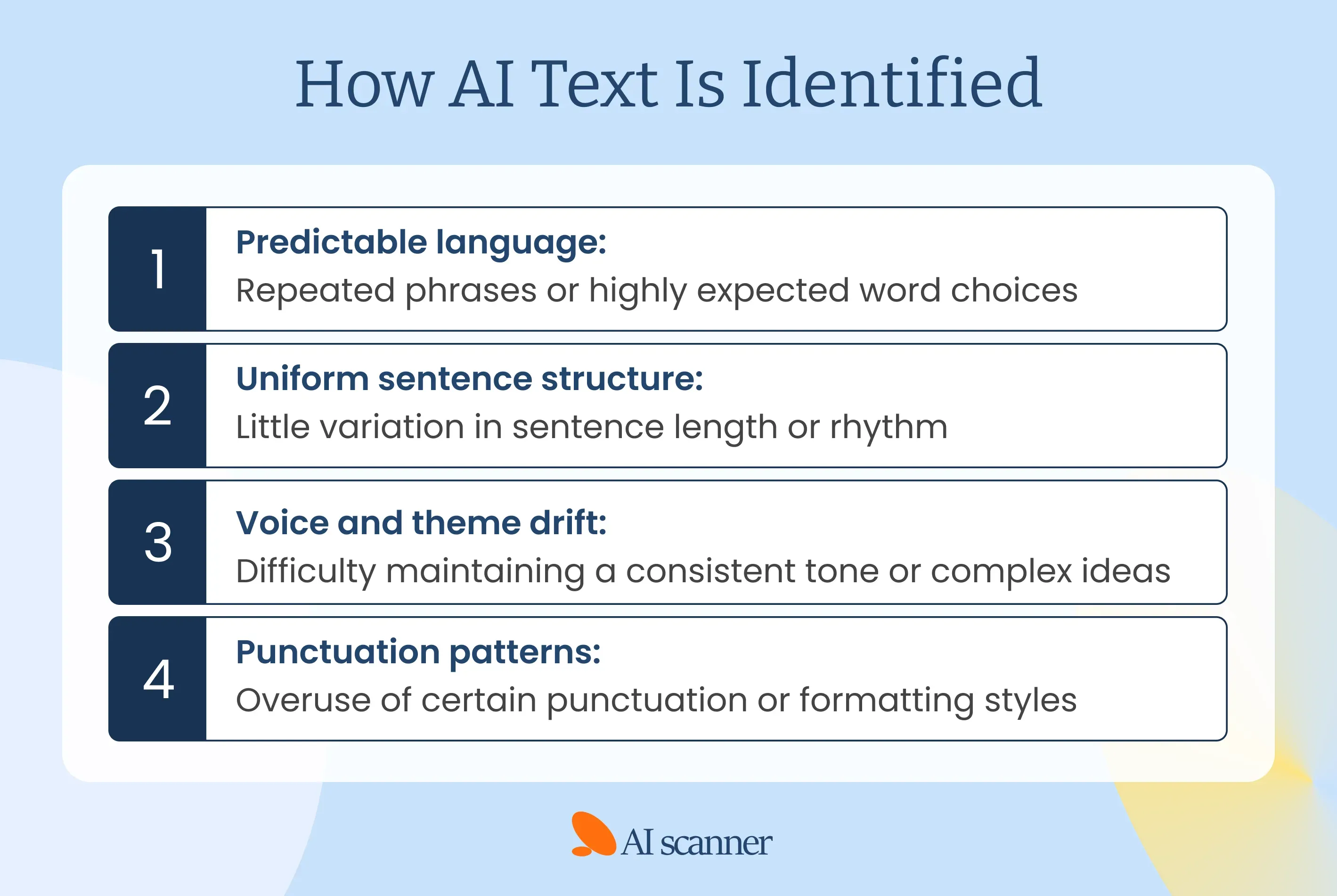
AI text detectors follow a step-by-step process that focuses on how writing behaves rather than what it argues. The identification process usually includes the following checks:
- Predictable language patterns: Detection tools scan for phrases and word choices that appear too frequently or follow highly probable sequences that many AI writing tools tend to produce.
- Uniform sentence structure: Text with consistently similar sentence length or structure often stands out. Human writing usually shifts rhythm as ideas develop, while AI output can feel mechanically even.
- Voice and theme drift: Detectors look for subtle inconsistencies in tone or difficulty sustaining complex ideas across longer passages, a signal noted by tools like QuillBot.
- Punctuation and formatting habits: Repeated use of specific punctuation styles or formatting patterns can raise flags, especially when they appear more consistently than in typical human writing.
Limitations of AI Text Detectors
Even when the AI text detectors working process is sophisticated, these tools come with important limits that affect how results should be interpreted:
- False positives: Detectors can mistakenly flag human-written text as AI-generated, especially when the writing is formal, structured, or concise. Turnitin’s guidance notes that lower confidence scores are particularly prone to this issue.
- Rapidly evolving AI models: As AI models improve, their writing increasingly mirrors natural human patterns. This makes it harder for detectors to separate AI output from genuine human writing over time.
- Dependence on hybrid methods: No single signal is reliable on its own. Effective detection depends on combining multiple techniques such as perplexity, burstiness, and embedding analysis, a point emphasized by Adobe.
- Mixed AI and human editing: Text that starts as AI-generated and is later revised by a human often loses clear detection markers, reducing detector accuracy.
- Style and creativity gaps: Unconventional or highly creative writing can confuse detectors because it falls outside the patterns seen in training data.
- Lack of definitive proof: AI detection tools return probability scores, not evidence. A high AI likelihood score suggests similarity to AI writing patterns, not authorship certainty, which is why results should guide review rather than replace human judgment.
Common Use Cases for AI Text Detectors
AI text detectors are used by different groups for different reasons, but the goal is usually to understand how content was created and assess its reliability.
- Educators: Teachers and academic institutions use detectors to review assignments, support academic integrity policies, and decide when further discussion or review is needed.
- Publishers: Editors and publishers rely on detection tools to assess submissions, maintain editorial standards, and identify large-scale automated content before publication.
- Recruiters: Hiring teams use detectors to evaluate application materials and writing samples, especially when written communication is a key part of the role.
- Web content writers: Writers and content teams use detectors to check drafts and adjust tone or structure before publishing.
- Politics, journalism, and social media: Detection tools help flag automated messaging, coordinated campaigns, or misleading content in high-impact public spaces.
- Businesses: Organizations use detectors to review internal documents, marketing copy, and outsourced content.
Difference Between AI Text Detectors and Plagiarism Checkers
AI text detectors and plagiarism checkers are often confused, but they serve very different purposes.
| Feature | AI text detectors | Plagiarism checkers |
|---|---|---|
| Primary goal | Estimate the likelihood of AI-generated writing | Identify copied or reused content |
| What they analyze | Language patterns, sentence structure, and predictability | Text similarity against databases and web sources |
| Typical output | Probability or likelihood score | Percentage of matched or duplicated text |
| Can flag original text | Yes, through false positives | No, the original text is not flagged |
| Detects paraphrasing | Sometimes, depending on patterns | Often, if similarity remains |
| Focus of evaluation | Writing behavior | Content source |
Smart Ways to Use AI Text Detectors Effectively
AI text detectors are most useful when they support judgment rather than replace it. Their results make more sense when users understand how the tools work, what they can realistically detect, and where their limits begin. Using them carefully helps avoid misinterpretation and overconfidence in a single score.
- Recognize their limits: View AI detection results as guidance rather than final judgment. These tools rely on probability scores and can sometimes mislabel both human-written and AI-assisted text.
- Cross-check results: Running the same text through multiple detection tools helps reveal inconsistencies and reduces over-reliance on a single score.
- Understand common AI writing patterns: Familiarity with predictable phrasing, uniform sentence length, and repetitive structure makes detector results easier to interpret.
- Consider context and purpose: Academic essays, technical documents, and creative writing behave differently. Evaluate results in light of the text’s goals and audience.
- Be transparent about use: When AI tools are allowed, clear disclosure helps avoid misunderstandings and supports ethical use.
- Combine with originality checks: AI detection works best alongside plagiarism checkers and human review as part of a broader content evaluation process.
The Bottom Line
AI text detectors are built to analyze how writing behaves, not to determine authorship with certainty. They rely on language patterns, statistical signals like perplexity and burstiness, and comparisons with known AI and human text to estimate likelihood. While these tools can be helpful across education, publishing, and content review, they also come with limits. False positives, evolving AI models, mixed human-AI editing, and stylistic variation all affect accuracy. That’s why detection results work best when combined with context, multiple tools, and human judgment rather than treated as final proof.
If AI detection has become a challenge or a source of uncertainty, AI Scanner offers a practical solution. It helps analyze writing patterns, surface potential AI signals, and present results clearly, making it easier to interpret detection outcomes without overreliance on a single score.
Don’t Let Detectors Misread Your Writing
AI Scanner reduces false positives by analyzing multiple signals instead of relying on a single metric.
FAQs
Sources
- Gonzaga University Library. (2025). Generative AI detection tools. Gonzaga University Research Guides. Retrieved from https://researchguides.gonzaga.edu/GenerativeAIforFaculty/AIDetectors
- University of Kansas Center for Teaching Excellence. (2025). Careful use of AI detectors. Retrieved from https://cte.ku.edu/careful-use-ai-detectors
- University of San Diego Legal Research Center. (2025). Generative AI detection tools: The problems with AI detectors. Retrieved from https://lawlibguides.sandiego.edu/c.php?g=1443311&p=10721367